What Is a Pool Waterstop in a Gunite Pool?
A pool waterstop is a barrier used at a concrete joint to help limit water movement through that joint. In a gunite pool, its placement depends on where separate sections of concrete meet and how the shell is designed.
If you're planning a custom pool, the joint detail matters more than the shape you see in the finished shell. Here's how waterstops fit into gunite construction and how they differ from other ways to manage water.
Key Takeaways
A waterstop addresses a path through a concrete joint. A continuous gunite shell may have fewer joints than a pool built in separate placements, so the design determines where joint treatment is needed.
Waterstops, sealants, and expansion joints have different jobs. Each must fit the construction plan rather than being treated as a substitute for the others.
What Does a Pool Waterstop Do?
Concrete joints can create a route for water to move between adjoining sections of a pool shell. A pool waterstop is positioned within a joint to interrupt that route. Depending on the joint and the surrounding conditions, it can help limit water movement out of the pool or moisture entering from outside.
This matters in Southwest Florida, where heavy rain and shallow groundwater can put moisture against the outside of a shell. A waterstop addresses the joint itself, though. It doesn't make porous concrete waterproof or repair a structural crack.
Gunite is the structural concrete of the pool. The plaster, quartz, pebble, or other finish goes on later and has a different role.
Where Might a Gunite Pool Need a Waterstop?
The location follows the actual construction joint , not every corner or change in shape. Many gunite pools are formed as connected shells, with the crew shaping the floor, walls, steps, and benches during placement.
Floor, Wall, and Step Connections
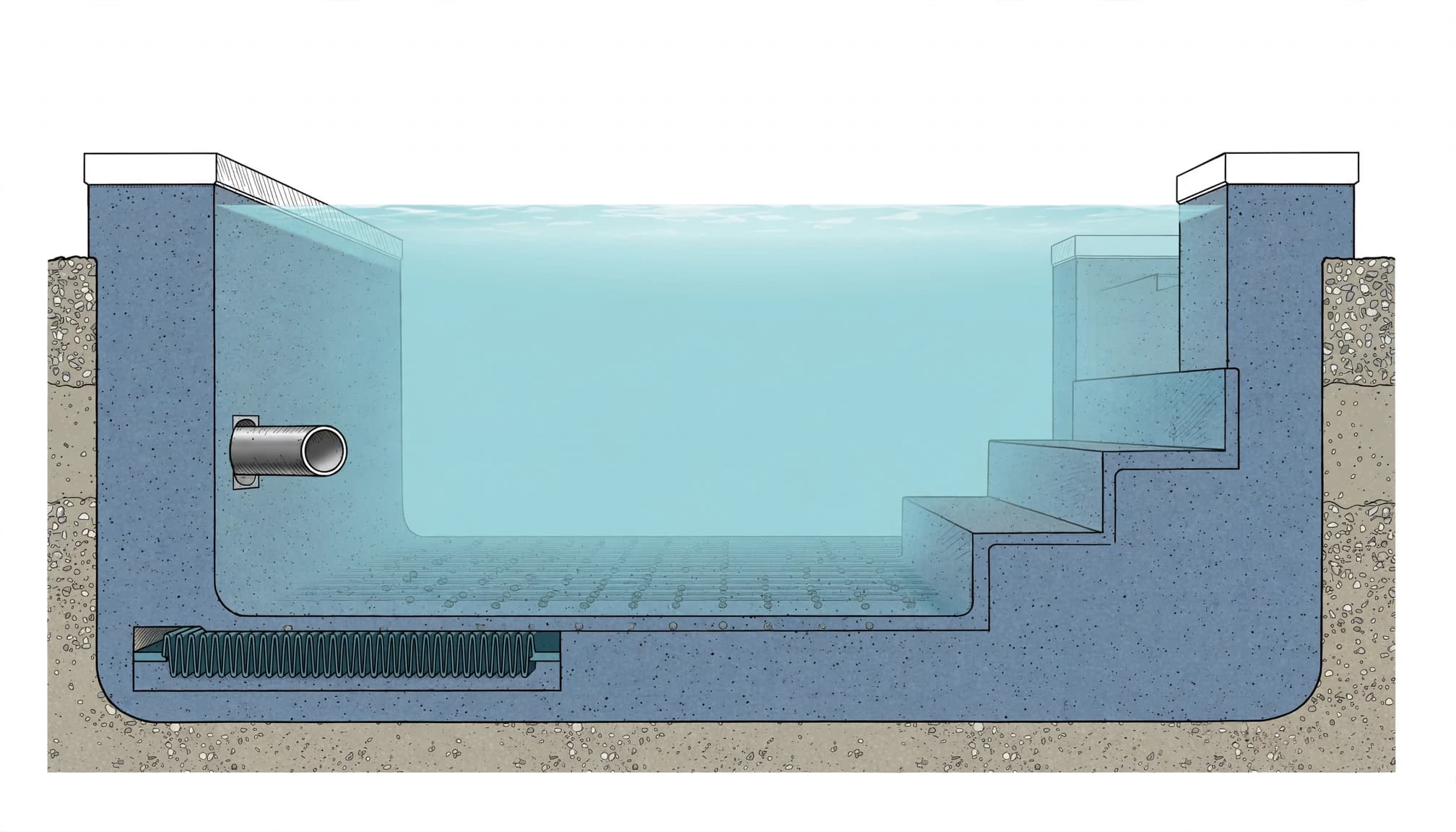
Where the floor meets a wall, a waterstop may be part of the joint detail if those sections are built in separate concrete placements. The same distinction applies to steps and benches: a visible change in shape isn't automatically a joint.
A construction joint exists where one concrete placement ends and another begins. If the crew forms a step and its adjoining wall as part of a continuous shell, their connection doesn't automatically need a separate waterstop.
Raised Spas and Other Features
An attached spa, raised wall, or other structural feature can add complexity to the shell. If the construction plan calls for separate concrete placements, the connection between them may need a joint treatment.
Plumbing fittings also pass through the shell, but a pipe penetration isn't the same thing as a construction joint. Fittings need details suited to the penetration and the surrounding waterproofing system.
Waterstop vs. Sealant and Expansion Joint
Waterstops and Sealants
A waterstop addresses a path within a joint . Sealant is generally applied at an accessible joint or gap surface and can help prevent water or debris from entering that opening.
The two can be used as parts of a larger joint detail, but they aren't interchangeable. A bead of sealant at a visible edge doesn't automatically protect the full depth of a concrete construction joint.
Expansion Joints
An expansion joint is a planned separation that allows adjoining materials or structures to move relative to each other. The joint may include sealant and other components chosen for that movement.
A waterstop is a water-control component. Some movement joints may include one as part of their design, but installing a waterstop doesn't turn an ordinary construction joint into an expansion joint.
Plan Joint Details Before Gunite Placement
Joint locations belong in the structural and construction plan. Once concrete covers the work, access becomes harder, and a waterstop intended for a joint can't be treated as an afterthought.
Before the shell is placed, crews also arrange reinforcing steel and plumbing around the pool's shape. Our guide to pool construction steps after excavation explains how those parts come together.
A pause in concrete placement can create a cold joint if the earlier concrete has begun to set before the next placement. Its condition and treatment depend on the project. A construction joint or cold joint isn't automatically evidence that the finished pool will leak.
Waterstops Are One Part of Shell Waterproofing
Water can travel through concrete pores, cracks, and areas around fittings as well as joints. For that reason, a waterstop addresses one potential path rather than the entire shell.
Our guide to gunite pool shell waterproofing covers how shell condition, groundwater, and the planned finish affect the choice of protection. A coating or finish also can't substitute for structural repair when a crack is moving or extends through the shell.
Pool Waterstop FAQs
Does every gunite pool need a waterstop?
Waterstop needs depend on the shell design and its joints. A pool built as a continuous shell has different joint details from one constructed in separate sections.
Does water loss mean a waterstop has failed?
Water loss alone doesn't identify the cause. Evaporation, plumbing, equipment, fittings, and shell conditions can all be involved. Our guide to pool crack causes and repairs explains why a visible crack also needs context.
Plan for the Joint, Not Just the Finish
A pool waterstop helps control water movement at a concrete joint. Its location follows the structural design and the way the shell is built.
For a custom gunite pool, the useful next step is to discuss joint details while the construction plan is taking shape. That gives the shell, its connections, and the finish a coordinated starting point.