Vanishing Edge Pools for Punta Gorda Waterfront Homes
A waterfront view can make an ordinary pool placement feel like a missed opportunity. Infinity edge pools bring the waterline toward a canal, Charlotte Harbor, or river horizon, creating a visual effect that connects the pool to the surrounding landscape.
For Punta Gorda homeowners, infinity edge pools offer that view, but their performance depends on more than appearance. Elevation, seawall distance, drainage, saltwater exposure, hurricane considerations, equipment access, and site suitability all shape the design. Careful planning also helps protect water quality by limiting runoff, debris, and salt exposure around the pool system.
The right project starts with the property itself. Engineering constraints should guide the design, rather than letting the visual concept dictate the site.
Key Takeaways
- Infinity edge pools can connect a Punta Gorda waterfront home to a canal, Charlotte Harbor, river horizon, or preserve when the vanishing edge follows the strongest sightline.
- Site elevation, seawall distance, flood exposure, setbacks, drainage, soil, and equipment access should guide the design before construction drawings are finalized.
- A properly sized catch basin, dedicated hydraulic system, auto-fill controls, waterproofed dam wall, and salt-resistant finishes support reliable performance and water quality.
- Gunite allows custom geometry for irregular waterfront lots, elevation changes, raised spas, sun shelves, and long edges that fixed fiberglass shells may not accommodate.
- Long-term ownership includes regular water testing, basin and equipment inspections, storm preparation, corrosion checks, drainage maintenance, and current pool barrier compliance.
Why Vanishing Edge Pools Fit Punta Gorda Waterfront Views
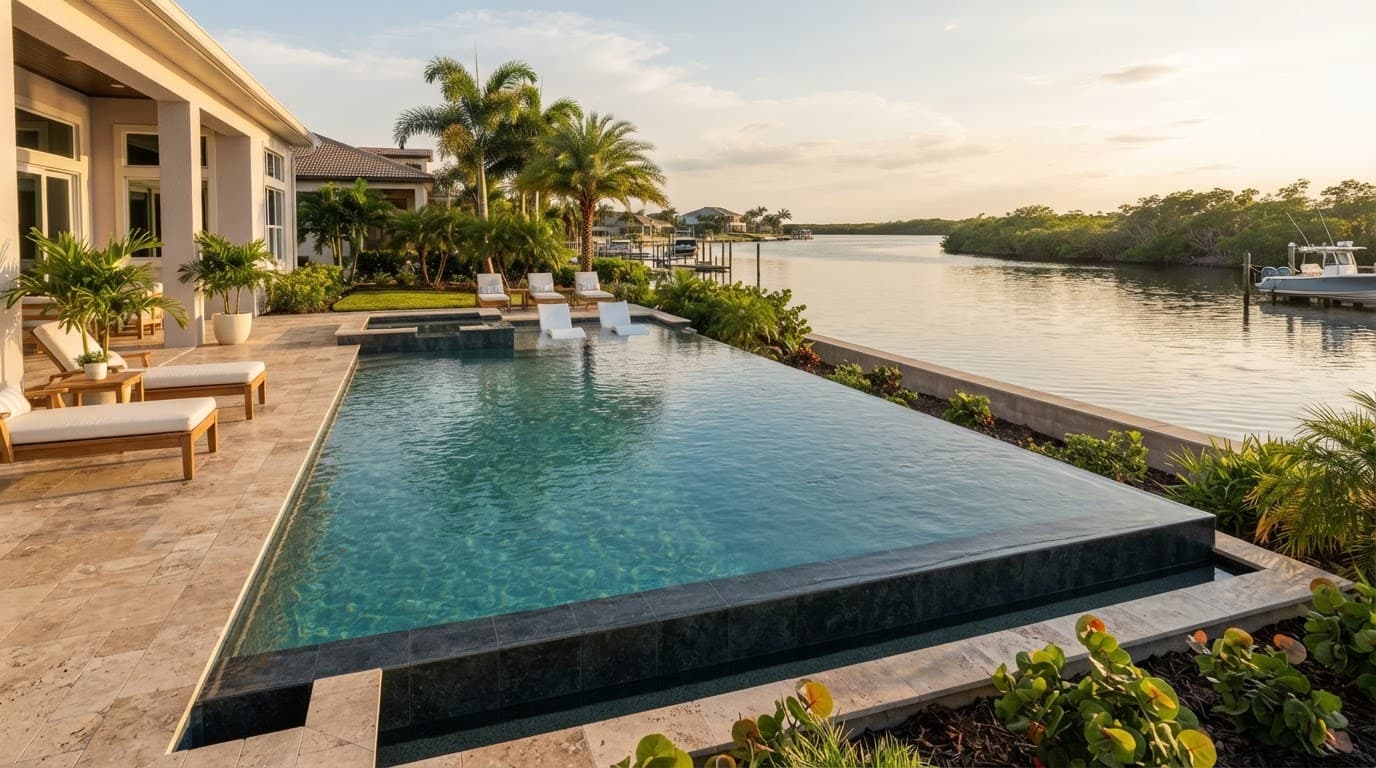
Infinity edge pools use a low overflow wall and concealed collection basin. From the patio, this visual effect makes the water appear to meet the canal or open water beyond.
Negative edge pools and infinity-edge terminology often refer to a similar visual concept. The phrase zero edge pools is sometimes used loosely, but it doesn't mean the water has no edge. A single vanishing edge differs from perimeter overflow, which collects water around multiple sides.
Infinity edge pools work best when the edge faces the longest, clearest view. Charlotte Harbor, a wide canal, or a waterfront preserve can anchor Punta Gorda's scenic landscape. The design can also direct attention away from neighboring homes or a nearby seawall.
Match the edge to the strongest sightline
The disappearing edge should frame the view you use most often. Infinity edge pools may use a broad, straight edge facing the water or a shorter edge at an angle.
Pool depth and deck elevation matter, too, because a high deck can weaken the effect. On pie-shaped or offset-canal properties, infinity edge pools can follow the strongest sightline with custom gunite geometry and safe circulation. Fiberglass pools use preformed geometry, while gunite keeps the observer's eye close to the pool surface.
Create a destination beyond swimming
Infinity edge pools often become the center of a custom backyard. A raised spa, sun shelf, fire feature, or shaded seating area can complement the main water view without blocking it.
The best layouts preserve open paths between the house, pool, and dock access. They also leave room for furniture, pool barrier requirements, and service access needed to protect water quality. A dramatic edge means little if daily use feels cramped.
How Vanishing Edge Pools Move Water
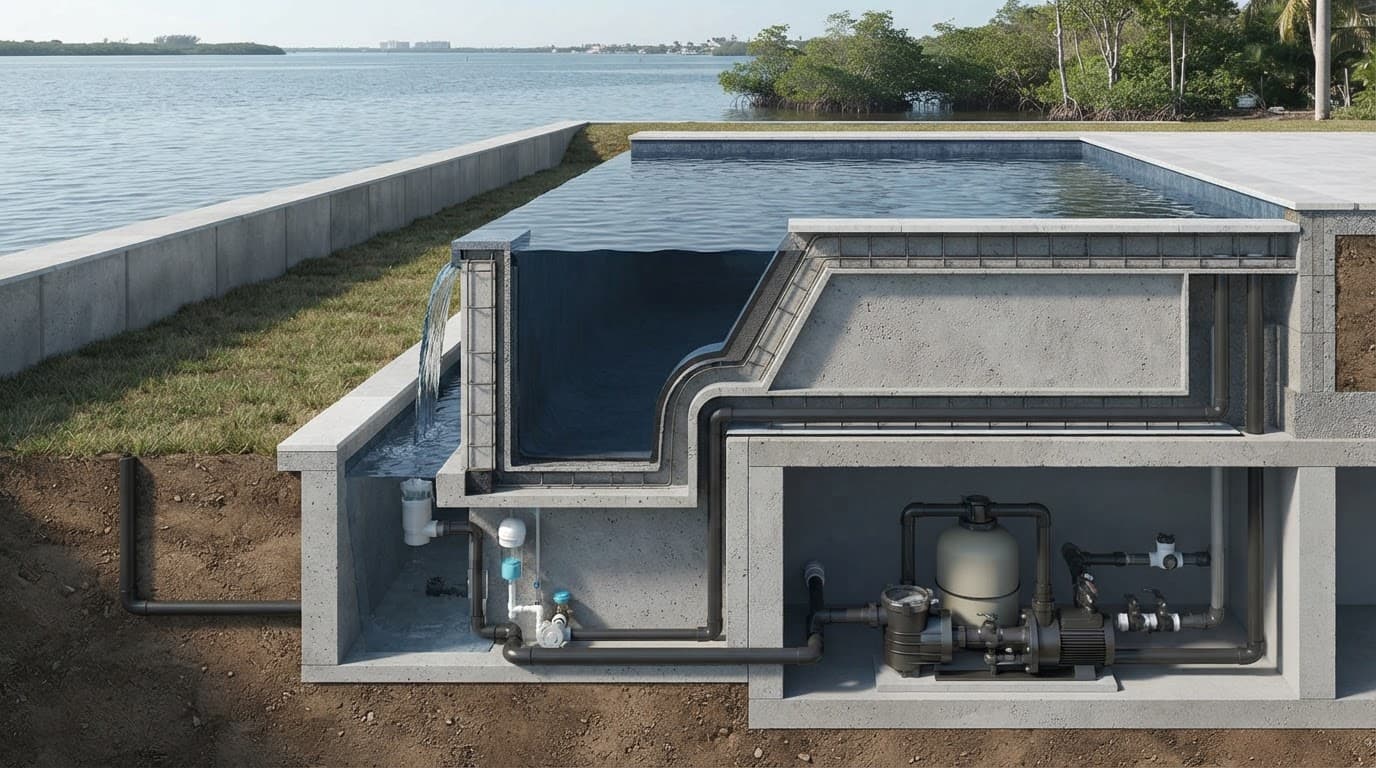
Traditional pools hold water at a fixed height inside the main shell and use skimmers to draw surface water. Infinity edge pools use a second body of water, the catch basin, to collect overflow and return it through dedicated plumbing. A single-edge design differs from a perimeter overflow system, which collects water around multiple sides rather than only at one edge.
Water passes over the dam wall, the weir that establishes the edge, then enters the lower basin. The overflow system filters it before returning it to the pool, creating a constantly renewed waterline for infinity edge pools. Even water flow preserves the visual line and supports water quality.
The catch basin needs real capacity
The basin is far more than a hidden detail. For infinity edge pools, it must hold normal overflow, rainfall, wind-driven water, and a bather surge created when people enter the pool.
A basin that is too small can overflow during a busy afternoon. During that surge, the catch basin must absorb the added volume without spilling into the yard, equipment area, or seawall zone. A poorly shaped basin may trap debris, affect water quality, or make service difficult. Capacity calculations should consider the pool's surface area, overflow-edge length, expected bather load, and local rain conditions.
The basin must absorb a sudden surge without spilling into the yard, equipment area, or seawall zone.
A properly sized basin also gives the system enough reserve water to keep the vanishing edge looking even. Low reserve volume can interrupt the visual line and strain the circulation system.
Pumps and auto-fill systems require separate planning
Infinity edge pools usually need more than a standard skimmer-pool setup. Their hydraulic systems may include a filtration pump, an edge pump, suction lines from the catch basin, return lines to the pool, valves, and automation controls.
An auto leveling system belongs where its sensor can detect the correct operating level for the system. Poor placement can add water when the basin already holds excess rainwater. That wastes water and can cause overflow. A builder should also place the circulation system where technicians can reach it without crossing finished deck areas or working beside the water.
Site Elevation, Seawalls, and Drainage Come First
Waterfront construction starts with an accurate survey and site suitability review for infinity edge pools. It should confirm property lines, easements, utilities, grades, soil, seawall or bulkhead, and flood exposure. It should also establish the home's finished-floor elevation and the pool's water level.
Punta Gorda waterfront lots can also fall within flood hazard areas. The City of Punta Gorda identifies floodplain applications among its building forms, and projects in flood zones may receive additional review. Conditions vary by parcel, so current zoning, floodplain, and permitting requirements should be confirmed before construction drawings are complete.
Set the pool back from the waterfront wisely
Local waterfront setbacks can differ from ordinary rear-yard setbacks. Punta Gorda zoning materials include a general 25-foot waterfront setback for permanent and accessory structures. Limited provisions may apply differently to infinity edge pools, patios, and cages near a waterway.
Those details don't create a universal site rule. The measurement point may involve the seawall, bulkhead, waterway, or another mapped boundary. Your design team should verify the parcel's current zoning and floodplain conditions with the city before locking in the edge location.
A vanishing edge sometimes needs more room behind it than homeowners expect. For infinity edge pools, the water-facing service zone often needs space for the catch basin and access path. It may also include a structural wall, drainage route, and safe working space.
Send rainwater away from the pool structure
During hurricane rainfall, contaminated runoff can reach the pool area, affecting water quality and soil near a seawall. Therefore, deck drains, yard grading, roof runoff, and overflow outlets must work together. Water should move away from the home, pool shell, and equipment pad without discharging where it could undermine nearby soil.
A builder may use deck drains, swales, and controlled drainage routes based on the final grading plan. The pool's overflow system, including any perimeter overflow, should remain separate from yard drainage. Don't treat the pool's collection basin as a yard drain. Roof water, fertilizer residue, mulch, and storm debris can affect water quality if they enter the pool system.
Why Gunite Is a Strong Choice for a Custom Edge
Gunite is a site-built method used for concrete pools, including infinity edge pools. Unlike fiberglass pools, it offers flexibility for a custom backyard that fixed shells cannot always match.
It can follow irregular lot lines, accommodate raised spas and sun shelves, or use a long edge tuned to the view.
That flexibility also helps when elevation changes between the house, deck, pool, and seawall. For infinity edge pools, a gunite plan can account for those transitions instead of forcing the site to fit the fixed geometry of fiberglass pools.
Build the dam wall for water and weather
The dam wall is the weir that creates the vanishing effect. It needs precise forming, stable reinforcement, and a uniform top line for even water flow. Small variations can make the spill heavier on one side.
Waterproofing behind the finish is equally important. If water enters areas it shouldn't reach, minerals can migrate through masonry and create efflorescence. Persistent moisture can also affect reinforcing steel over time. A properly detailed waterproofing system, tile installation, and expansion-joint plan protect the wall beneath the surface.
Choose finishes that tolerate salt air
Finishes also influence how infinity edge pools perform in a waterfront setting. Punta Gorda waterfront homes face humid air, wind-driven rain, and airborne salt. Hardware, light niches, railings, heat pumps, and exposed fasteners should resist corrosion in that environment.
Porcelain tile is a popular choice for the overflow edge because it offers consistent sizing and holds up well in wet conditions. Glass tile can create a rich waterline, although it raises material and installation costs. The practical choice depends on water quality, cleaning expectations, pool chemistry, saltwater exposure, sun, and budget.
What Drives the Construction Costs of an Infinity-Edge Project
Traditional pools have a simpler scope than waterfront infinity edge pools. Negative edge pools may require added excavation, hydraulic systems, equipment, and a catch basin. Their scope can also include structural detailing, a waterproofing system, tile, controls, permitting, drainage, access, and startup work.
No reliable flat price fits every Punta Gorda project. Access for excavation equipment, soil conditions, elevation changes, demolition, permitting, drainage, deck materials, and finish selections can shift the investment substantially.
Spend where performance depends on it
The first dollars should go toward structural engineering, hydraulic design, waterproofing, drainage, and durable equipment. These items support the pool every day, even though most remain hidden after completion.
After that, homeowners can choose visual upgrades that complement infinity edge pools and support how they use the custom backyard. A large-format porcelain deck, premium interior finish, spillover spa, LED lighting, or fire bowls can each change the final scope. Reviewing a detailed allowance schedule helps separate necessities from features that can be adjusted.
Homeowners should ask a pool builder for a detailed scope and allowance schedule covering site evaluation, design revisions, the permitting plan, excavation sequence, gunite work, tile installation, and startup responsibilities. A clear custom pool construction process also helps homeowners understand when these stages occur.
Consider long-term ownership, not only the build price
Infinity edge pools use more equipment and have more water-exposed surfaces than a traditional design. Pool maintenance and water quality may require closer attention after heavy rain, wind events, salt exposure, or high bather use.
However, the pool can make a waterfront patio much more usable and visually cohesive. For many owners, the value lies in daily enjoyment and how the pool complements the property. Property value can be one consideration, but no resale return is guaranteed.
Maintaining a Waterfront Infinity Edge
The steady flow in infinity edge pools can improve surface circulation. It helps the circulation system move leaves, pollen, and fine debris toward the overflow rather than leaving them at a single skimmer line.
Still, water quality depends on regular testing and balanced chemistry. Consistent filtration and clean baskets protect water quality, too. Debris entering the catch basin can affect water quality, so its basket needs separate inspection.
Follow a consistent service routine
A pool professional should inspect basin levels, pump operation, filter pressure, valves, the auto leveling system, and automation settings regularly. Infinity edge pools also require basin and edge checks that differ from a full perimeter overflow design. Homeowners should watch the water level, an uneven edge, a sudden basin drop, or water appearing where it should not.
Useful habits include:
- Empty its basket after windy days or heavy leaf drop.
- Keep the tile line clean so water crosses the weir evenly.
- Test and balance pool water according to the finish and sanitizer system.
- Inspect exposed metal components for corrosion from saltwater exposure and address small issues early.
- Clear deck drains before the summer rainy season and after major storms.
Gunite pool design and construction should include accessible equipment placement in a custom backyard design. Hard-to-reach pumps and valves can make pool maintenance a nuisance.
Prepare for storms before they arrive
Waterfront homes need a storm plan for the pool area. Secure loose furniture, store removable accessories, and clear drains before a tropical system reaches Southwest Florida. Follow the equipment manufacturer's instructions for shutoff and restart procedures.
After the storm, inspect infinity edge pools for debris, equipment damage, deck drains, and surrounding soil before restarting the system. If floodwater or debris entered the swimming pool, or floodwater reached electrical equipment, a qualified pool professional should assess water quality and the system before use.
Permits and Safety Details Need Early Attention
Florida's residential swimming pool barrier law in Chapter 515 should be checked against current statutory language and official guidance. For infinity edge pools, verify barrier height, openings, self-closing and self-latching gates, and gate direction before treating them as definitive requirements.
Punta Gorda may provide a Swimming Pool Spa Package and Pool Barrier Compliance Checklist in its building forms. Verify current municipal forms and confirm whether building, floodplain, or zoning review applies to the parcel and project scope.
Design safety into the finished space
A pool cage, fence, wall, or combination of barriers can support a high-end backyard plan. For infinity edge pools, the layout should protect children while preserving the water view from primary living areas.
Place gates where adults use them naturally, away from the pool's most inviting entry point. Confirm current requirements for gate placement, latching, and direction before finalizing the design.
Lighting, non-slip deck surfaces, handrails, and clear steps also matter after sunset. The pool builder, designer, and permitting professionals should coordinate barrier placement, equipment access, elevation information, and current review requirements for infinity edge pools. Safety features look better when the design accounts for them from the beginning.
Frequently Asked Questions
What is a vanishing edge pool?
A vanishing edge pool uses a low overflow wall, or weir, that allows water to spill into a concealed catch basin. From the right viewing angle, the waterline appears to connect with the canal, harbor, or surrounding horizon.
Does an infinity edge pool work on every Punta Gorda waterfront lot?
No. The design depends on elevation, sightlines, seawall location, drainage, soil, flood exposure, access, and applicable setbacks. A survey and site suitability review should confirm whether the property can support the pool and its collection basin.
Why does an infinity edge pool need a catch basin?
The catch basin collects water that flows over the edge and returns it through dedicated plumbing. It must also hold rainfall, wind-driven water, and bather surge without overflowing into the yard, equipment area, or seawall zone.
Is gunite better than fiberglass for a custom waterfront edge?
Gunite provides more flexibility for irregular lot lines, elevation changes, long vanishing edges, raised spas, and custom sun shelves. Fiberglass pools use preformed geometry, so their shape may be less adaptable to a complex waterfront site.
What maintenance does a waterfront infinity edge pool require?
Owners should monitor water level, basin baskets, pumps, filter pressure, valves, automation, tile, drains, and exposed metal components. Heavy rain, storms, salt exposure, and debris can affect water quality and equipment, making regular service especially important.
A Waterfront Pool That Earns Its View
Infinity edge pools reward careful planning because hidden components shape the visible waterline. A gunite shell, correctly sized basin, formed edge, and seawall-aware grading shape a custom backyard around the view.
When the edge, deck, and setbacks align, infinity edge pools join the waterfront view instead of competing with it. Drainage, durable salt-resistant materials, hurricane planning, accessible equipment, water quality, and routine service help infinity edge pools perform as intended. With careful planning, vanishing edge pools should look effortless because their hidden structure supports the view.