
Fort Myers Soil Test for a Gunite Pool: What to Know
Do you need a Fort Myers soil test for a gunite pool? Usually, there is no blanket answer. Gunite and shotcrete construction alone doesn't automatically determine whether testing is needed; site conditions, pool location, and engineering requirements matter more.
A sandy or previously filled lot may need closer review before excavation. High groundwater, drainage problems, nearby structures, seawalls, and signs of unstable soil can affect the design. Ask your builder and licensed engineer how they will evaluate the property, then confirm current requirements with the local permitting authority.
When a Fort Myers soil test may be needed for a gunite pool
Gunite, often called shotcrete, is concrete applied under pressure over reinforcing steel. That method affects shell construction, but it doesn't reveal the soil's bearing capacity, groundwater level, or settlement risk. Those factors come from site evaluation and engineering.
On a straightforward residential lot, signed and sealed pool plans may provide enough information for design and permit review. If the soil is uncertain or the pool sits near a foundation, wall, slope, or canal edge, the engineer may request a professional geotechnical investigation.
Why gunite alone doesn't decide it
Choosing a concrete shell instead of another pool type doesn't create an automatic testing rule. The shell still depends on stable subgrade, proper reinforcement, drainage, and backfill.
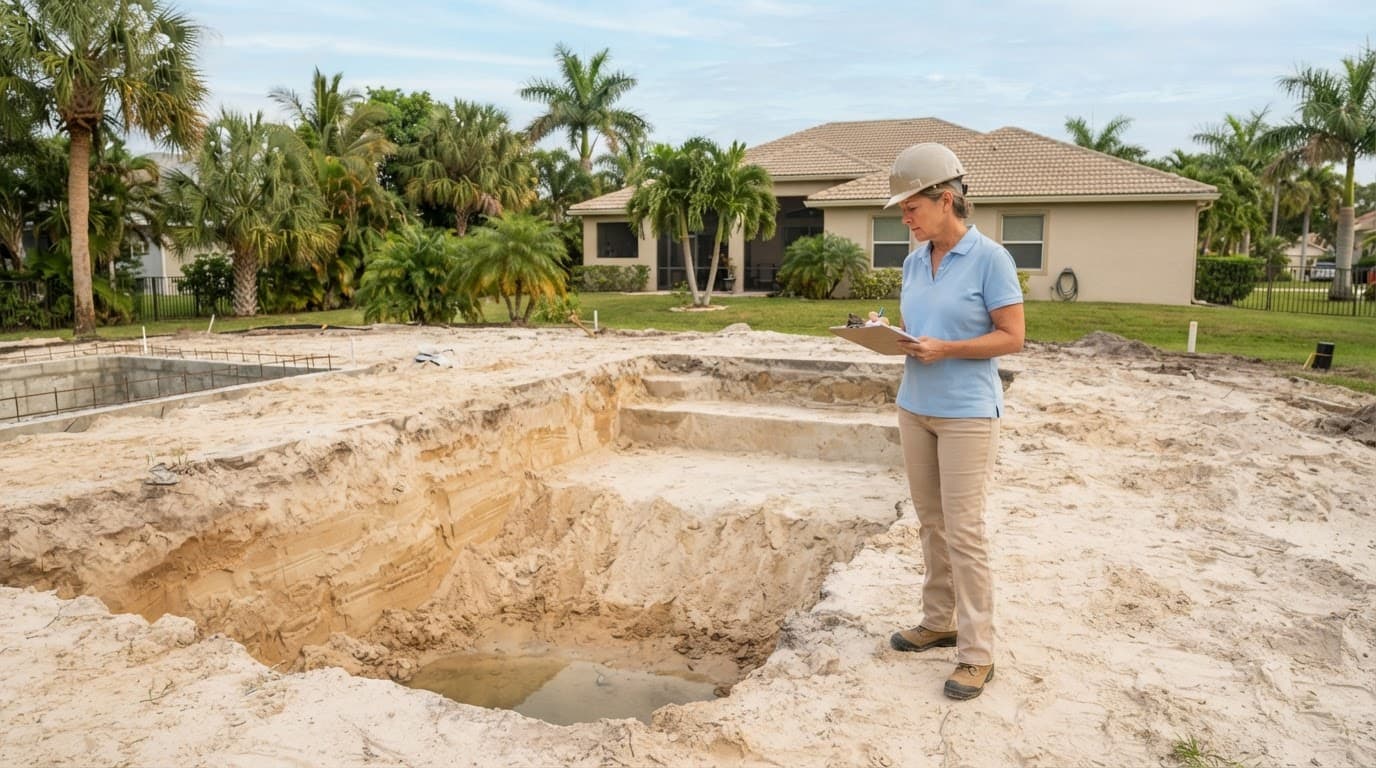
Excavation can also reduce support near a house, retaining wall, seawall, or other improvement. A basic look at excavated soil may identify obvious soft spots, but it can't document subsurface layers or settlement behavior.
What local plans and permits may require
The City of Fort Myers checklist for site-built pools calls for signed and sealed plans. It asks for details such as reinforcement, concrete thickness and type, depth limits, piping, and the pool's relationship to adjacent foundations, retaining walls, finished grades, and slopes. It also calls for extra engineering when the pool falls within the angle of repose of an existing foundation.
Lee County's residential pool guide calls for signed and sealed engineered plans and hydraulic calculations for inground pools. Florida Building Code Chapter 18 governs soil and foundation investigations, including reports when applicable site or groundwater conditions trigger them. These documents don't state that every residential pool needs a geotechnical report, so confirm the current rule for your address.
Southwest Florida lot conditions that deserve attention
Southwest Florida properties can vary even within the same neighborhood. The surface may look firm while loose sand, fill, or wet material sits below the planned pool.
Sandy or previously filled lots
Sand is common in the region, but not every sandy lot behaves the same way. Native, compacted material differs from loose fill placed during earlier grading or construction.
If records are unclear, the site has been reworked, or the yard contains soft spots and depressions, a Fort Myers soil test can give the engineer better information about bearing and settlement.
That information may affect excavation limits, compaction work, shell design, deck support, or additional drainage measures. It can also expose a condition before concrete, tile, and decking make changes harder and more expensive.
Water, drainage, and nearby structures
High groundwater deserves attention during excavation and after the pool is complete. Water can enter the hole, weaken exposed soils, complicate dewatering, and affect how the pool and surrounding deck are supported.
Poor yard drainage may direct runoff toward the excavation or leave the finished deck with nowhere to discharge water. The risk increases near canal edges, seawalls, bulkheads, retaining walls, sloped yards, additions, and older foundations.
Watch for cracking in nearby slabs, leaning walls, recurring ponding, sink-like depressions, or soil that feels unusually soft after rain. These signs don't prove a problem, but they justify an engineer's review before work starts.
What a professional soil investigation actually covers
An informal digging check and a geotechnical investigation answer different questions. Knowing the difference helps you evaluate recommendations from a builder or engineer.
Geotechnical work versus basic soil observation
A professional investigation may use borings, test pits, field measurements, and laboratory testing, depending on the property and the engineer's scope. The resulting report can describe soil layers, groundwater, allowable bearing assumptions, compaction needs, and settlement concerns.
By contrast, a basic observation usually examines visible soil during layout or excavation. It can help spot conditions that need attention, but it isn't a substitute for a signed professional report when the design team or building official requires one.
How results can shape the pool design
The engineer can use the findings to recommend excavation support, dewatering, soil replacement, compaction, drainage, or structural changes. The report may also address differential settlement, varying soil strength, expansive soils, liquefaction potential, or loads from nearby structures when those issues apply.
A pool builder then coordinates the findings with the structural engineer, site plan, and construction sequence. Soil information is most useful before the pool size, elevations, deck, and water features become difficult to change.
Questions to ask before excavation
Don't wait until the excavator finds unexpected soil. Get clear answers while the design and permit package are still adjustable.
Ask your pool builder or engineer:
- Has the lot been reviewed for native soil, fill, groundwater, drainage, and signs of movement?
- Does the pool fall within the angle of repose of the house, a retaining wall, seawall, or another foundation?
- Will a professional Fort Myers soil test be part of the design, and who will prepare and sign the report?
- If testing isn't planned, what site information supports that decision?
- How would the findings affect the pool shell, deck, drainage, excavation, and construction schedule?
Also ask when the investigation occurs. A clear Fort Myers pool building process places engineering and permits before excavation, not after a problem appears in the hole.
How testing can prevent expensive pool problems
Testing doesn't remove every construction risk, and it can't replace careful installation. It can, however, give the design team evidence before excavation begins.
Better soil information may identify a need for compaction, soil replacement, groundwater control, altered elevations, or added support near an existing structure. Those decisions can reduce the chance of uneven settlement, pool or deck cracking, drainage failures, and redesign after construction has started.
A report may add a step early in the project, but redesigning a pool after excavation, steel, plumbing, or concrete work has begun can create greater disruption. The right timing matters as much as the test itself.
Conclusion
A gunite or shotcrete pool in Fort Myers doesn't automatically need a soil test. The need depends on the lot, groundwater, drainage, nearby structures, slope or seawall conditions, visible instability, and the requirements of the engineer or building official.
Before approving excavation, ask for a site-specific answer in writing. When conditions are uncertain, a professional geotechnical report can provide useful information for preventing settlement, cracking, drainage trouble, and avoidable redesign. Your pool's concrete shell is only as dependable as the ground supporting it.