Shotcrete vs Gunite for Southwest Florida Pools
The choice between shotcrete vs gunite can sound more complicated than it is. Both are pneumatically applied concrete systems used to build durable swimming pool shells, and neither is automatically the right choice for every Southwest Florida property.
The main difference is how the concrete mixture reaches the nozzle. Gunite uses a dry mix with water added at the nozzle, while shotcrete arrives as a wet mix. The quality of either system depends more on preparation, materials, application, curing, and drainage than on the label alone.
What Shotcrete and Gunite Actually Mean
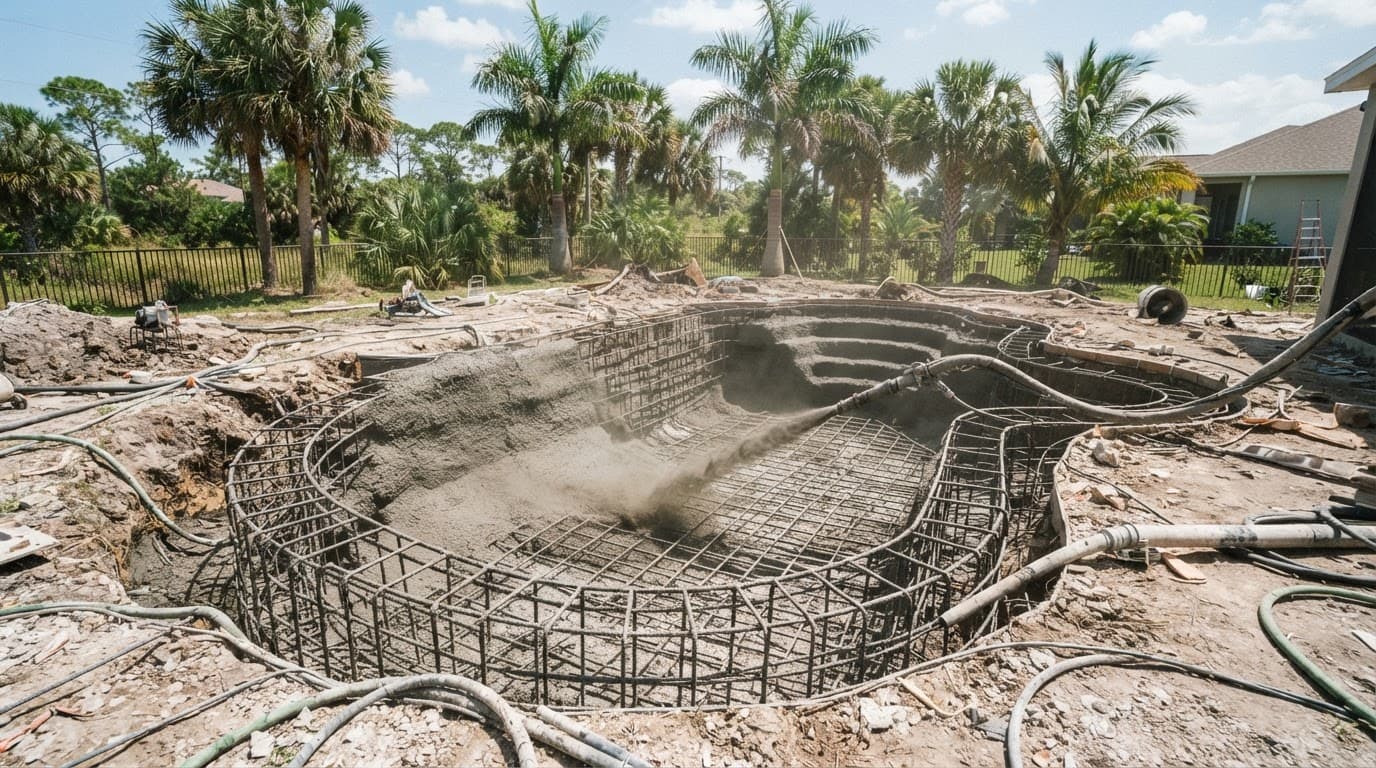
Shotcrete and gunite both create a monolithic concrete pool shell around a designed steel reinforcement cage. A pump or compressor moves the material through a hose, and a trained nozzle operator sprays it onto the pool walls and floor at high velocity.
The common industry distinction is simple:
- Gunite uses dry ingredients. The nozzle operator adds water immediately before the mixture exits the hose.
- Shotcrete uses a wet concrete mixture. The water is added during batching, before the material reaches the pump.
- Both systems require properly placed steel, a suitable concrete mix, skilled application, and controlled curing.
- Both can form freeform pools, raised spas, tanning ledges, benches, steps, and water features.
Terminology can vary between contractors and regions. Some pool builders use "shotcrete" as a general term for pneumatically applied concrete. Others use "gunite" for dry-mix application and "shotcrete" for wet-mix application. Ask the builder which process they mean and what mix specification they plan to use.
The application method matters, but it isn't the only factor that determines performance. A well-designed gunite shell can outlast a poorly applied shotcrete shell. The same is true in reverse.
A pool's long-term performance usually reflects the entire construction process, not the single word used for the concrete system.
How the Two Pool Construction Methods Differ
With gunite, dry cement and aggregate travel through the hose. Water enters at the nozzle, where the operator controls the moisture level as the concrete is applied. This method gives the nozzle operator direct control over the water added to the mix.
That control can help the crew adjust for changing conditions. However, the operator must have the training and judgment to maintain consistent water content. Too much water can weaken the mixture. Too little can reduce workability and create placement problems.
Shotcrete arrives at the job site as a wet mixture, similar to other pumped concrete applications. The batch plant controls the water and mix proportions before delivery. The crew then pumps the material through the hose and sprays it onto the steel reinforcement.
Wet-mix shotcrete can support efficient placement on larger projects. It may also produce less rebound in some applications, although results depend on the crew, equipment, nozzle angle, and surface conditions. Rebound is material that bounces away from the wall instead of becoming part of the pool shell. Crews must remove it rather than bury it inside the structure.
Both systems require careful attention around fittings, steps, benches, corners, and plumbing penetrations. Those areas need full coverage and proper consolidation. A skilled nozzle operator keeps the hose at the correct distance and angle while building the shell to the specified thickness.
For homeowners, the most useful comparison is not simply shotcrete versus gunite. Ask how the contractor will handle steel placement, plumbing pressure testing, excavation conditions, concrete testing, curing, and inspection. A detailed pool construction process gives you more useful information than a material label by itself.
Southwest Florida Conditions That Affect Pool Shells
Southwest Florida presents conditions that deserve attention during concrete pool construction. Cape Coral, Fort Myers, and nearby communities often have sandy soils, a high water table, intense sun, heavy rain, and seasonal storms. Those conditions affect excavation, drainage, scheduling, and curing.
A high water table can complicate excavation and may require temporary water management. If groundwater enters the excavation, the builder must control it before placing the steel and concrete. Water pressure also matters after construction, especially when a pool is drained for repairs or resurfacing.
Sandy soil can provide good drainage in some locations, but every lot has its own conditions. Fill areas, disturbed soil, nearby structures, and poor compaction can create movement that affects decks, plumbing, or the pool shell. A qualified builder should evaluate the site rather than assume every Southwest Florida property behaves the same way.
Heat and direct sunlight can cause fresh concrete to lose moisture too quickly. Fast moisture loss increases the risk of shrinkage problems. The crew's curing plan should account for weather, wind, exposure, and the size of each placement area.
Rain creates a different concern. A storm during excavation can affect soil stability and site access. Rain after concrete placement can also interfere with finishing if the surface hasn't set properly. Good scheduling helps, but weather planning and job-site protection matter just as much.
For these reasons, shotcrete vs gunite isn't a universal winner in Florida. The better system is the one the contractor's crew can apply consistently under local site and weather conditions.
A Practical Way to Choose Between Shotcrete and Gunite
Use the following framework when comparing pool proposals. It helps you evaluate the work instead of relying on sales language.
1. Confirm the actual application method
Ask whether the contractor will use dry-mix gunite or wet-mix shotcrete. Request the planned concrete strength, aggregate details, and water-cement requirements when those specifications are available.
If the proposal only says "concrete pool" or "gunite pool," ask for clarification. Different companies may use the same term for different processes.
2. Ask who will operate the nozzle
The nozzle operator controls much of the placement quality. Ask how long the crew has applied pneumatically placed concrete and who will supervise the work.
The operator should maintain proper velocity, distance, and angle. The crew also needs to remove rebound and overspray from areas where it doesn't belong. Concrete should not hide loose debris, standing water, or poorly supported plumbing.
3. Review the preparation before concrete arrives
A strong shell starts before the first load is sprayed. The contractor should place and support the steel reinforcement according to the structural design. Plumbing should be secured, pressure-tested, and positioned so the concrete fully surrounds it.
The excavation should match the approved design. Forms and bond beams need careful construction, especially around raised walls, spillover spas, sun shelves, and attached water features.
4. Compare the curing plan
Ask how and when the crew will begin curing the shell. Fresh concrete needs moisture control while it gains strength. In hot Southwest Florida weather, that step deserves a clear answer.
A contractor should explain how the shell will be kept damp and protected from rapid drying. Follow-up instructions should also cover when the pool can receive finishes, water, backfill, and other construction loads.
5. Check what the proposal includes
Two bids may use similar concrete systems but cover different scopes. Compare excavation, steel, plumbing, equipment, tile, coping, interior finish, deck work, permits, cleanup, and warranty terms.
A lower initial price may exclude site dewatering, difficult access, upgraded structural work, or features such as a raised spa or waterfall. Ask what could change the price before signing.
6. Look beyond the concrete label
Review local references and completed pools with similar designs. A compact rectangular pool has different placement challenges than a freeform pool with multiple benches, deep curves, or raised features.
The best choice usually matches the crew's experience, equipment, project size, and site conditions. That standard applies equally to shotcrete and gunite.
Durability, Cracking, Curing, and Cost
Both concrete systems can provide a durable pool shell when the builder controls the major variables. Steel placement, concrete quality, shell geometry, soil movement, drainage, curing, and finish installation all affect the result.
Cracking isn't caused by the word "gunite" or "shotcrete" alone. Shrinkage, ground movement, poor reinforcement, inadequate coverage, plumbing stress, and rapid drying can all contribute to problems. Some surface checking can differ from a structural crack, so a qualified professional should assess any concern.
Curing deserves special attention in Florida. The shell should retain enough moisture for the concrete to develop strength. Direct sun, wind, and high temperatures can shorten the time available for proper moisture control. A clear curing schedule is a better sign than a claim that one system never cracks.
Cost also varies by project. Wet-mix shotcrete may fit a large placement efficiently, while dry-mix gunite may suit a crew's equipment and workflow. Access, pool size, excavation, steel, pumping, disposal, features, and local material prices often affect the total more than the method name.
Ask each contractor for an itemized proposal. Compare the same scope, specifications, finish, warranty, and site assumptions before deciding.
FAQ: Shotcrete vs Gunite for Florida Pools
Are shotcrete and gunite both durable?
Yes. Both are pneumatically applied concrete systems that can produce a durable pool shell. Durability depends on the mix, steel reinforcement, application quality, curing, drainage, and overall construction process.
Which one cracks less?
Neither system has a guaranteed advantage against cracking. Cracks can result from shrinkage, soil movement, poor curing, insufficient reinforcement, or construction defects. Proper design and installation matter more than the label.
How long should a concrete pool shell cure?
The contractor should provide a curing plan based on the concrete mix, weather, and project conditions. Fresh concrete needs moisture control while it gains strength. Your builder should also explain when backfilling, finishing, and filling the pool can occur.
Is shotcrete or gunite less expensive?
There isn't one lower-cost option for every project. Equipment, crew availability, delivery, access, pool size, excavation, and included work all affect pricing. Compare itemized bids with matching scopes.
Which option is best for Southwest Florida pools?
Both can work well in Cape Coral, Fort Myers, and surrounding areas. Choose the system that the contractor applies consistently, with strong preparation, qualified nozzle work, proper curing, and a clear warranty. Local experience with high water tables, sandy soils, heat, rain, and storm conditions should carry more weight than the material name.
Conclusion
The shotcrete vs gunite decision is important, but it shouldn't distract you from the full construction process. Both systems can create a high-quality concrete pool when the design, reinforcement, placement, curing, and site preparation receive proper attention.
Ask for clear specifications, an itemized proposal, and a practical explanation of how the crew will handle your property. In Southwest Florida, the best pool shell comes from the right process and workmanship , not from choosing one label automatically.