
Pool Filter Comparison for New Fort Myers Pools
A new pool can have beautiful tile, a sun shelf, and a powerful pump, yet cloudy water will steal the enjoyment quickly. The filter is the equipment pad component that captures fine debris before it settles, stains surfaces, or feeds algae.
This pool filter comparison helps Fort Myers homeowners choose between cartridge, sand, and DE filters based on real ownership needs. Your pool's gallons, plumbing layout, water features, and maintenance preferences all matter before the first equipment pad is installed.
Start Your Pool Filter Comparison With the Job at Hand
Every filter traps suspended particles after the pump pushes water through it. The trapped debris stays inside the filter, while cleaner water returns to the pool. Filter performance is often measured in microns, which are tiny units of measurement. A human hair is roughly 70 microns wide.
A finer filter can produce clearer water, but it may also demand more attention. Meanwhile, a larger filter has more room to collect debris before pressure rises and cleaning becomes necessary.
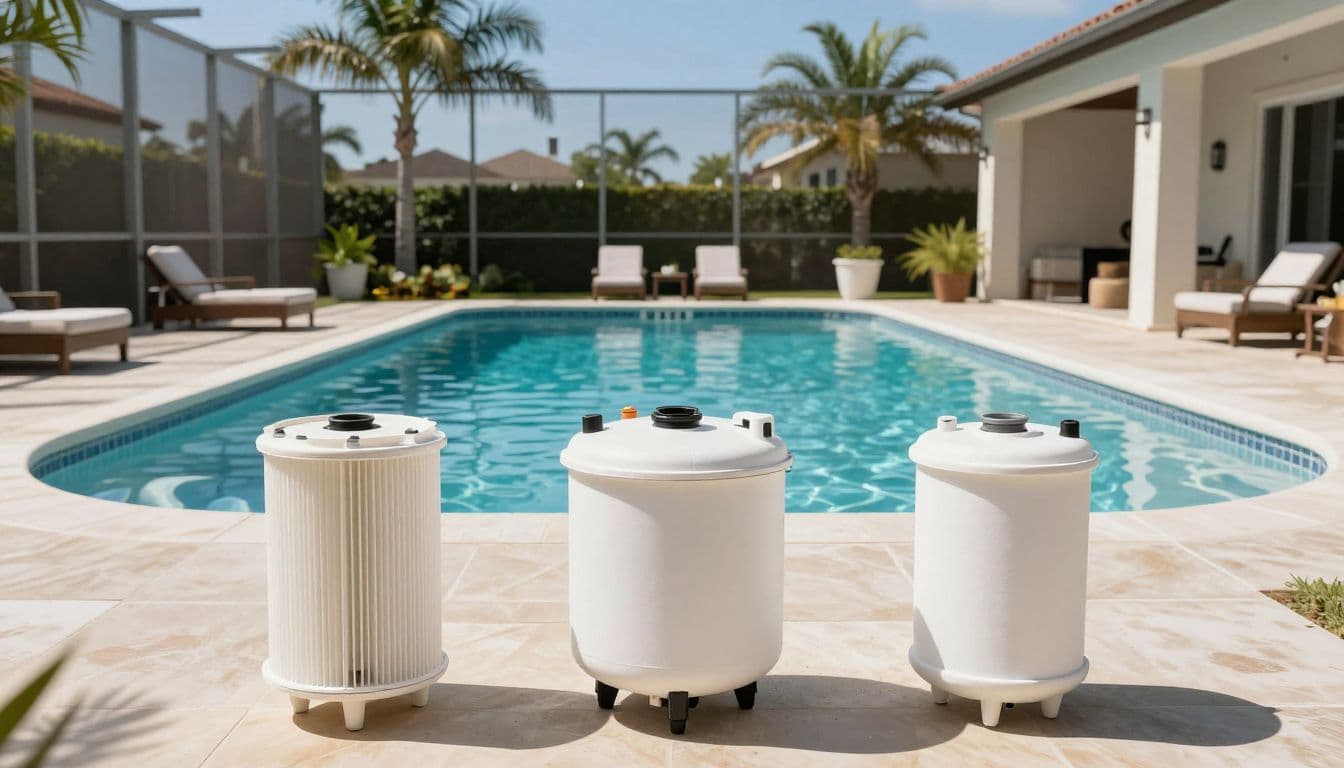
| Filter type | Typical particle capture | Routine cleaning method | Water used during cleaning | Best fit |
|---|---|---|---|---|
| Cartridge | About 10 to 20 microns | Remove and hose off cartridges | Low | Owners who want to conserve water |
| Sand | About 20 to 40 microns | Backwash and rinse | High | Simple, familiar operation |
| DE | About 2 to 5 microns | Backwash or take apart, then add DE | Moderate to high | Owners who prioritize polished water |
The numbers above are general ranges. Proper circulation, chemical balance, and a correctly sized pump still control how well any filter performs.
A too-small filter needs frequent cleaning, regardless of the filter media inside it. Extra filter area usually reduces maintenance more than a small jump in filtration rating.
Cartridge Filters: Low Water Use and Straightforward Care
Cartridge filters hold pleated fabric elements inside a tank. Pool water passes through the folds, and the fabric catches fine debris. Because they do not need backwashing, cartridge systems preserve pool water and avoid sending treated water out of the system.
Why cartridge filters suit many Fort Myers pools
Fort Myers pools often run year-round, and many sit beneath screened enclosures that collect pollen, dust, and small organic debris. A generously sized cartridge filter handles that steady load well. It also works well with variable-speed pumps operating at lower speeds for longer periods.
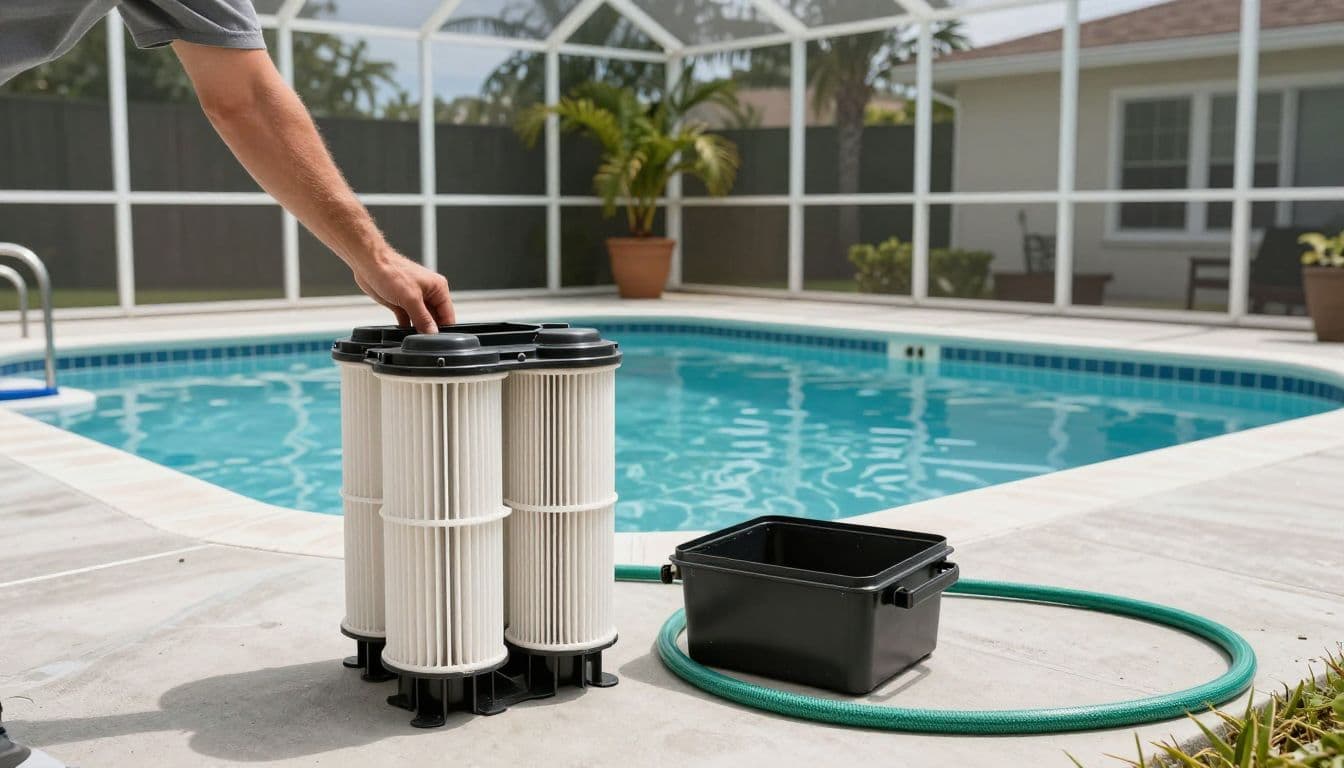
A homeowner can clean a cartridge filter with a garden hose, then reinstall it. In most cases, that process wastes far less water than a sand or DE backwash cycle. Replacement cartridges are a future expense, although quality elements often last several years with gentle cleaning.
What maintenance feels like
Cleaning takes more hands-on time than turning a multiport valve. You must shut off the pump, release pressure, open the tank, lift out the cartridges, and rinse between pleats. Avoid pressure washers because they can damage the fabric.
Watch the pressure gauge after the filter has been freshly cleaned. When pressure climbs about 8 to 10 psi above that clean baseline, it's time to inspect and clean the elements. A pool builder can size the tank so this task is occasional rather than constant.
Sand Filters: Familiar Equipment With a Water Tradeoff
Sand filters use a bed of special graded sand inside a round tank. As water moves through the media, the sharp sand edges collect debris. A valve reverses the flow during backwashing and flushes accumulated dirt through a waste line.
The case for a sand filter
Sand filtration is easy to understand and forgiving. Backwashing usually takes only a few minutes, and the media can last for years before replacement. For a homeowner who wants simple valve-based maintenance, that routine has clear appeal.
Sand also performs well with a properly sized pump and steady circulation schedule. It catches larger debris effectively, while good sanitizer levels and brushing support the filter's work.
Backwashing changes the ownership math
A sand filter discards water each time you backwash. For example, a system that backwashes at 50 gallons per minute for three minutes sends about 150 gallons to the waste line, before the rinse cycle.
That loss matters during dry periods, especially when you must refill the pool and rebalance its chemicals. Frequent backwashing may also signal an undersized filter, a dirty pool, or a water chemistry issue. Never discharge backwash water into a storm drain or onto an area where it can affect neighbors or waterways. Follow local disposal rules and ask your builder where the waste line will terminate.
DE Filters Deliver the Finest Water Clarity
DE means diatomaceous earth, a fine powder made from fossilized microscopic algae. The powder coats internal filter grids and forms an exceptionally fine filtering layer. When maintained properly, a DE filter can remove particles that other residential filters allow through.
When DE is worth the extra effort
DE filters are popular with homeowners who notice every bit of haze and want a highly polished water appearance. They can be a strong choice for pools with exposed water features, pale interior finishes, or a high number of bathers.
However, high clarity does not replace sound pool care. A DE filter cannot correct poor circulation, low sanitizer, an unbalanced pH level, or an algae bloom. It only removes what reaches the equipment pad.
Plan for media and periodic deep cleaning
After backwashing a DE filter, you add fresh DE powder through the skimmer while the pump runs. The correct amount depends on the filter's grid area and the manufacturer's instructions. Too little reduces filtering performance. Too much can restrict flow.
At least once a year, many DE filters need a more complete teardown and grid inspection. Torn grids, worn manifolds, or a damaged air-relief screen can allow DE back into the pool. That service is manageable, but it is more involved than cleaning a cartridge filter.
Fort Myers Conditions Affect Filter Size and Maintenance
Southwest Florida heat keeps pools active for much of the year. Heavy summer rain can dilute chemicals and bring fine debris into the water. Wind carries pollen and dust, while nearby palms and oaks can add leaves, seeds, and tannins. These conditions make capacity as important as the filter style.
Pool volume and features set the baseline
A compact 10,000-gallon pool does not need the same equipment as a 25,000-gallon pool with a spa, bubbler, deck jets, and a raised waterfall. Water features add plumbing resistance and may call for dedicated pumps or carefully planned flow rates.
The filter must match the total system design. Your builder should account for pipe diameter, pump curve, pool volume, expected turnover, spa spillway flow, and the number of suction and return lines. Fort Myers pool construction services should include equipment planning early, not after the deck is complete.
Screens help, but they don't eliminate debris
A screened lanai reduces leaves and insects. It does not stop pollen, fine dust, sunscreen, body oils, or storm runoff. Homes without a cage usually need more skimming and may benefit from greater filter capacity.
Saltwater pools also need filtration. A salt chlorine generator creates chlorine from dissolved salt, but it does not remove particles. Pairing a salt system with the right filter gives you clearer water and fewer reasons to chase chemistry after storms.
Compare Total Cost, Not Only the Equipment Quote
The filter tank price is only one line in a new-pool budget. A more useful pool filter comparison includes water loss, replacement media, labor, chemical rebalancing, and how often you want to open the equipment.
Costs that continue after installation
Cartridge filters have periodic replacement elements. Sand filters need new media less often, but they consume water during backwashing and may increase chemical use after refilling. DE filters require ongoing DE powder, plus more detailed seasonal service.
Electricity depends more on pump selection and programming than on the filter alone. A variable-speed pump matched to properly sized plumbing can lower daily operating costs across all three filter types. Do not buy a filter based on an equipment-pad price without discussing the whole circulation system.
A practical recommendation for a new pool
For many new Fort Myers residential pools, a large cartridge filter is a balanced choice. It offers good water clarity, low water waste, and a maintenance routine most homeowners can manage. Choose a larger model when the pool has heavy landscaping, frequent use, or substantial water features.
A sand filter fits homeowners who prefer quick valve-based cleaning and accept the water cost of backwashing. It can also make sense where debris loads are high and a well-planned waste connection is available.
Choose DE when water clarity is your highest priority and you are comfortable with the added service steps. It is a strong performer, yet it needs careful handling and periodic inspections.
During the custom pool construction process, ask for the proposed filter model, its effective filter area, its clean pressure reading, and the recommended cleaning interval. Those details reveal far more than a generic label on the tank.
Clear Water Starts With the Right Long-Term Fit
The right filter is the one that fits your pool's size, feature load, yard conditions, and maintenance habits. Filter capacity often matters more than choosing the finest available media.
Cartridge filters conserve water, sand filters simplify backwashing, and DE filters deliver exceptional particle removal. Build the equipment pad around the life you plan to live beside the pool, not only the first day it fills.